Stay up to date with the latest news
Subscribe to our telegram channel

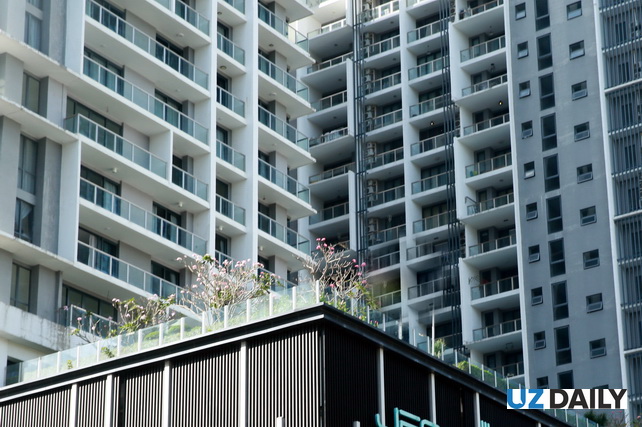
Tashkent housing market shows slowdown and structural shift
Tashkent, Uzbekistan (UzDaily.com) — The residential real estate market in Tashkent recorded a noticeable decline in activity in April 2026 amid structural changes in the composition of supply.
According to the Institute for Macroeconomic and Regional Studies (IMRS) under the Cabinet of Ministers of the Republic of Uzbekistan, the total number of housing sale listings amounted to 44,485 units, down 13.4% compared to March and 17.7% lower than in April 2025.
At the same time, the market continues to see a steady shift in supply toward newly built housing.
Primary market strengthens its position
The most significant structural trend is the growing share of the primary market. While it stood at 33.8% in January 2024, it reached 47.6% by April 2026 — an increase of 13.8 percentage points in just over two years.
The share of the secondary market declined from 66.2% to 52.4% over the same period. In absolute terms, 21,190 primary housing listings and 23,295 secondary listings were recorded in April. Monthly declines were observed in both segments: the primary market fell by 13.6%, while the secondary market declined by 13.2%.
Price dynamics show mixed trends across segments
Price developments in April 2026 were uneven, differing not only between primary and secondary markets but also across apartment types within each segment.
In the primary market, two- and three-room apartments showed positive monthly growth of 0.7% (+$11 per sq. m) and 1.8% (+$29 per sq. m) respectively. One-room apartments declined by 1.6% (-$27 per sq. m), while apartments with four or more rooms fell by 2.1% (-$34 per sq. m). Mid-range housing showed relative stability, while larger apartments continued to lose value.
In the secondary market, prices increased across all segments in April. The strongest growth was recorded in one-room apartments at 3.5% (+$51 per sq. m). Two-, three-, and four-room apartments saw more moderate increases of 0.4%, 1.2%, and 0.6% respectively.
Long-term trend analysis using STL decomposition shows that in the primary market, prices for one-room apartments are declining, while two-room apartments continue to rise. In the secondary market, growth is observed across all four housing categories.
District-level disparities exceed twofold gap
Data by Tashkent districts indicate significant geographical divergence in prices for fully finished housing. In the four-room primary market segment, prices range from $922 per sq. m in Sergeli district to $2,117 per sq. m in Mirabad district — a 2.3-fold difference. In the secondary market, the same segment ranges from $900 per sq. m in Sergeli to $1,677 per sq. m in Mirabad, a 1.9-fold gap.
The highest price levels are traditionally recorded in Mirabad, Yakkasaray, and Mirzo-Ulugbek districts. Mid-range values are seen in Shaykhantakhur, Yunusabad, Chilanzar, and Yashnabad districts.
The most affordable housing remains concentrated in Uchtepa, Almazar, and Sergeli districts.
Yashnabad district: price growth amid infrastructure expectations
Special attention is drawn to Yashnabad district, where significant annual price growth has been recorded in several housing categories. According to IMRS materials, this increase may be linked to intensified construction activity, infrastructure development, and expectations related to the “New Tashkent” project. The source notes that this factor remains hypothetical in terms of direct causality.
New cashless transaction rules show no immediate impact
IMRS also notes the introduction of a new system for cashless real estate transactions. According to the institute, no significant impact on price levels has been observed in the initial months of implementation. The assessment of its full market impact will be possible based on results from the second and third quarters of 2026.