Stay up to date with the latest news
Subscribe to our telegram channel

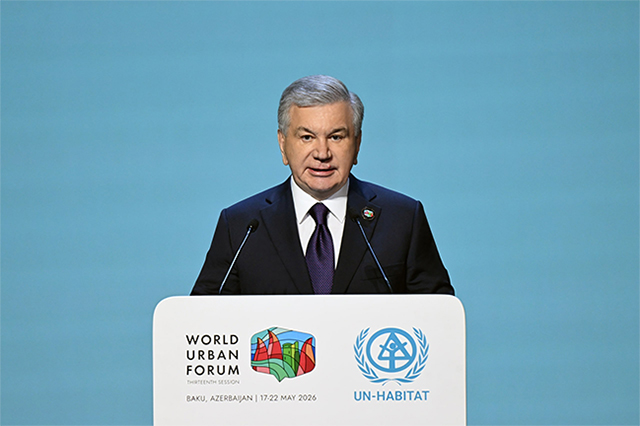
Uzbekistan President Proposes Smart Cities Alliance at UN Forum
Tashkent, Uzbekistan (UzDaily.com) — President of Uzbekistan Shavkat Mirziyoyev delivered a speech on May 18 at the Leaders’ Summit of the 13th session of the World Urban Forum in Baku, presenting five initiatives on sustainable urban development. He proposed creating an international alliance of smart and safe cities, establishing a UN-Habitat “Green City” award, and holding the 15th session of the forum in 2030 in New Tashkent.
Mirziyoyev thanked President of Azerbaijan Ilham Aliyev for the high level of organization of the event in Baku and expressed readiness to contribute to the large-scale constructive work being carried out across Azerbaijan, particularly in Karabakh, where entire cities have been restored in a short time and new residential complexes and modern infrastructure facilities are being built.
The Uzbek leader noted the relevance of the forum theme, “Housing for All: Safe and Sustainable Cities and Communities,” emphasizing that by the middle of the 21st century nearly 70% of the global population will live in cities. He said accelerating urbanization is creating a range of social challenges. Nearly 3 billion people worldwide lack adequate housing, over 1 billion live in informal settlements and slums, and more than 300 million have no shelter at all. Climate change, geopolitical tensions, and economic crises are driving new waves of global migration, reshaping population distribution across countries and cities. He stressed that urbanization has become a major factor affecting global stability and security and requires urgent and decisive action.
Mirziyoyev described sustainable urban development as a strategic priority for Uzbekistan. He said the country’s population is expected to grow from 38 million to 50 million within the next 15 years, while urbanization is projected to rise from 51% to 65%. He presented this as a unique opportunity for balanced territorial development and economic growth.
He highlighted large-scale housing construction in Uzbekistan, noting that annual housing output has increased tenfold over the past decade, reaching 238,000 apartments in 2025, and is expected to grow by 1.5 times by 2030. About $2 billion per year is allocated from the state budget to affordable housing programs. To address informal housing, a dedicated law was adopted in 2024, and documentation has been issued for nearly 100,000 homes. The share of renovation of dilapidated housing is planned to increase from 15% to 60%. A National Committee on Urbanization has been established to manage these processes.
The president said that under the “Yashil Makon” and “Taza Havo” programs, Uzbekistan aims to increase urban green coverage to 30% by 2030. The country also relies on the traditional mahalla system of local self-governance to improve urban management and living standards.
Mirziyoyev presented the New Tashkent megaproject, designed for a population of two million and described as a key embodiment of Uzbekistan’s urbanization strategy. The project incorporates advanced standards of green, smart, safe, and 15-minute city principles. Investment projects worth more than $25 billion have already begun at the first stage. He noted that the concept is being showcased at the Urban Expo held within the forum.
He added that similar “New Uzbekistan” residential developments are being implemented across all regions of the country. To date, 61 such housing clusters have been built, with plans to reach 100 by 2030. He expressed gratitude to UN-Habitat Executive Director Anacláudia Rossbach, as well as the World Bank, Asian Development Bank, and other financial institutions for their support in urban development and city planning.
The president outlined five initiatives. First, he called for broad implementation of balanced urbanization principles, emphasizing the need for harmonious development of small and medium-sized cities to ensure equal living conditions across regions.
Second, he proposed ensuring equal access for all countries to artificial intelligence and digital transformation in urban governance, and suggested forming an international alliance of smart and safe cities for systematic exchange of technologies, standards, and experience.
Third, he focused on providing quality and affordable housing for youth and vulnerable populations, and announced readiness to host an international forum in Samarkand next year on financing approaches in housing construction.
Fourth, he called for adopting common principles and standards for green city development in response to global climate change, and proposed establishing a UN-Habitat “Green City” international award.
Fifth, he highlighted the role of traditional self-governance systems in cities amid urbanization and proposed hosting the 15th session of the World Urban Forum in 2030 in New Tashkent, focusing on the role of local communities in sustainable urban development.
He expressed confidence that the forum would contribute to joint solutions, new initiatives, and the overall development of the sector.
#Shavkat Mirziyoyev