Stay up to date with the latest news
Subscribe to our telegram channel

Water Systems Under Strain: Sewage Modernization Strategic
Tashkent, Uzbekistan (UzDaily.com) — Water supply and wastewater treatment systems are becoming one of the key challenges for sustainable urban development. Population growth, rapid urbanization, climate change, and increasing industrial pressure are intensifying strain on water supply and drainage systems, many of which were built decades ago and are now operating at their limits.
According to international experts, a significant share of utility networks in transition economies requires large-scale capital modernization. Worn-out pipelines, outdated treatment facilities, and insufficient drainage capacity lead not only to water losses but also to serious environmental and public health risks.
For Central Asian countries, efficient water resource management is becoming particularly critical. Rising temperatures, declining river flows, and increasing water consumption are creating long-term challenges for the sustainable functioning of urban infrastructure.
One of the most pressing issues remains high water losses in utility networks. A significant portion of treated drinking water is lost before reaching consumers due to pipeline failures and the lack of modern monitoring systems. This results in additional costs for treatment, transportation, and energy supply, increasing pressure on the utility sector.
Experts emphasize that modernization of water supply infrastructure is now seen not only as a utility issue but also as a factor of economic efficiency. Reducing water losses helps lower operating costs, reduce pressure on water intakes, and improve the resilience of urban systems.
Equally important is the development of sewage and wastewater treatment systems. In many settlements, existing networks do not cover newly built residential areas, while treatment plant capacities no longer match the pace of urbanization. This creates risks of soil contamination, groundwater pollution, and water body degradation, directly affecting sanitary and epidemiological conditions.
Specialists note that effective wastewater treatment has become a key factor in public health and environmental safety. In this context, projects involving the construction of modern treatment facilities and the introduction of environmentally friendly technologies are gaining importance.
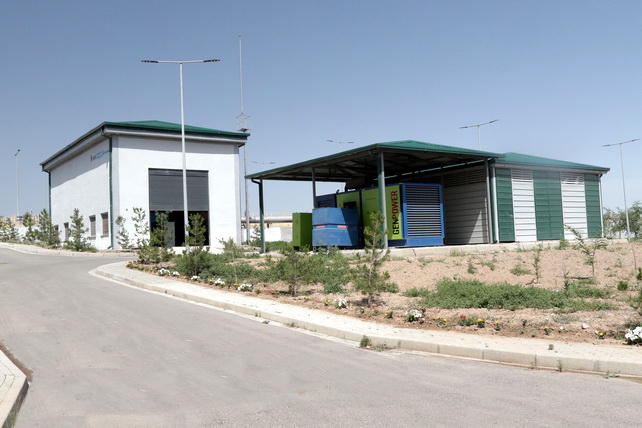
One example of such modernization is a new wastewater facility in Guliistan, where a press tour for media representatives and bloggers was organized on May 19 at a sewage treatment plant.
During the event, journalists were introduced to the technological stages of wastewater treatment, laboratory operations, and environmental monitoring systems. According to specialists, the facility was built using modern technologies, and the project cost amounted to US$ 7 million. The plant was commissioned on June 1, 2025, and is capable of treating up to 25,000 cubic meters of wastewater per day.
Particular attention during the press tour was given to the fact that wastewater treatment at the facility is carried out using a biological method. This technology is based on natural processes of organic pollutant decomposition using microorganisms and activated sludge. This approach is considered one of the most environmentally safe and effective wastewater treatment methods.
Experts explained that the biological method significantly reduces pollutant content without the need for large volumes of chemical reagents. This not only improves environmental safety but also reduces the negative impact on the surrounding environment.
As participants noted, the use of biological technologies is becoming especially relevant under conditions of growing water scarcity and stricter environmental requirements. After all stages of treatment, continuous laboratory monitoring of water quality and environmental indicators is carried out.
During the press tour, media representatives were also informed about post-treatment environmental monitoring and observed laboratory analysis procedures. Particular attention was paid to transparency in the utilities sector and public awareness of ongoing reforms.
Following the site visit, a press conference was held with representatives of Uzsuvta’minot and Syrdarya Suv Ta’minoti, where information was presented on the development of drinking water supply and wastewater systems in the region and across the country.
Chief Engineer of Syrdarya Suv Ta’minoti JSC, Mahmud Yarov, said that the level of centralized drinking water supply coverage in Syrdarya region has reached 88.4 percent. He added that this year, 182 kilometers of water pipelines and three water facilities are being completed using budget funds.
In addition, within the project to ensure 24-hour drinking water supply in Guliistan, 87 kilometers of pipelines have already been laid, improving water supply for 22,000 households, or more than 102,000 residents.
Head of the press service of Uzsuvta’minot JSC, Akmal Murodov, noted that system sustainability depends not only on infrastructure expansion but also on consumption culture, rational resource use, and payment discipline.
Experts emphasize that modernization of water supply and wastewater systems requires significant financial resources and long-term investment. For this reason, international financial institutions and public-private partnership mechanisms are playing an increasingly important role in the sector. Projects in the region are already being implemented with support from the World Bank, the Asian Development Bank, and the European Bank for Reconstruction and Development.
At the same time, digitalization is becoming a key direction in utility modernization. Modern monitoring systems enable real-time tracking of leaks, water quality, and treatment plant loads. Many countries are introducing automated pumping stations, smart water meters, and digital infrastructure management platforms.
Particular attention is also being given to the reuse of treated wastewater. In conditions of resource scarcity, recycled water is increasingly used in industry, agriculture, and urban landscaping, becoming part of broader rational water use strategies.
Against the backdrop of climate challenges, effective water resource management is increasingly seen as a strategic factor for sustainable development. The success of infrastructure modernization will largely determine environmental safety, quality of life, and long-term economic resilience.